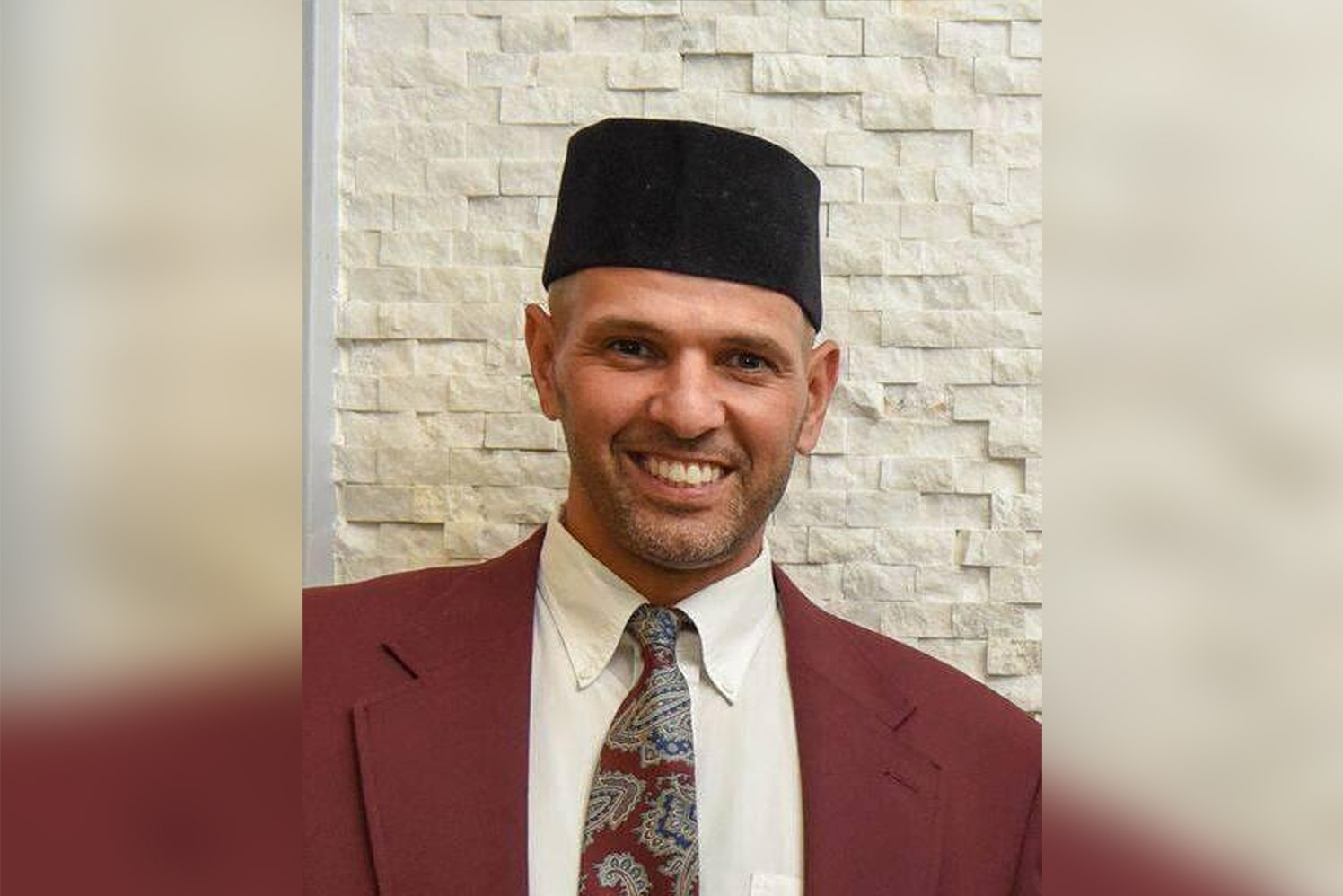
The expansive book by Dr. Omer Awass, Fatwa and the Making and Renewal of Islamic Law: From the Classical Period to the Present (2023), might be considered the culmination of a scholar’s lifelong research. For Dr. Awass, it’s just the start.
This winter break he spent in Dali, Yunnan province, China, where he immersed himself in Chinese language and culture. Over the last few years he has been studying Chinese with the aim of eventually being able to read Chinese historical texts. “After thoroughly exploring how Muslims have rationalized about the world,” he wonders, “How is it that other civilizations have reasoned? Long term, I would like to do a comparative view of the intellectual history of China.”
Dr. Omer Awass visits a historical Buddhist monastery, abbreviated as “San Ta” (in mandarin it means Three Towers), in Dali, Yunnan province, China, where he has been studying over the winter.
This Spring at American Islamic College, he is teaching Introduction to the Science of Hadith, Islamic History & Civilization 1800-Present, and a graduate course on Hadith Sciences. The history course parallels his forthcoming book, due out in 2026, Imposing Modernity in the Global South: Studies in the Coloniality and Decoloniality of Muslim Societies, a series of studies over the past two centuries concerning issues of coloniality and decoloniality. When talking about hadith sciences, he gets animated. “It’s really a uniquely developed way of doing historiography unlike other civilizations. The methodology is a distinct way of preserving history and historical reasoning. Here at AIC we get to teach our students these different ways of thinking. Hadith science wouldn’t be taught this way at other institutions,” he says. Beyond looking at it theoretically, he trains students to investigate hadith and practice the methodology. With so much focus on the breadth of history, when asked what he thinks about the future of Islamic law in light of the massive changes in technology and the impact of AI, he remarks, “Rationality is one of the characteristics that defines us as humans. How much of our own rationality are we going to surrender, instead of developing that which defines us? How can we purposefully use AI to enhance our humanity and not diminish it?”
Dr. Omer Awass at Lake Erhai in Dali, Yunnan Province, China, where he frequently went to study.
Walking helps clear his mind, and he is drawn to doing his research by the water – whether that’s Lake Michigan in Chicago or Lake Erhai in Dali, Yunnan Province, China.
Dr. Omer Awass is Associate Professor of Arabic & Islamic Studies and the Director of the MA program in Islamic Studies at American Islamic College.
By Stephanie Mirza, Staff Writer